

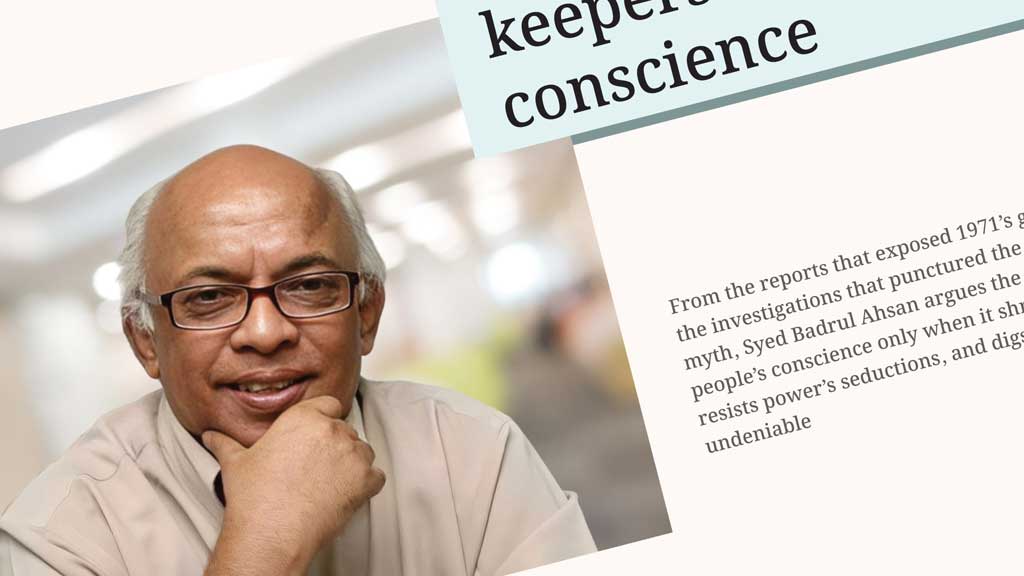
From the reports that exposed 1971’s genocide to the investigations that punctured the WMD myth, Syed Badrul Ahsan argues the press is the people’s conscience only when it shrugs off fear, resists power’s seductions, and digs until truth is undeniable
These are hard times for the media in diverse parts of the globe, for it is an age when for governments and regimes any mention of truth is grating to the ear. Of course, it sometimes cheers people when the media are referred to as the fourth estate. But how much of the truth is there in that statement?
In an era where political leadership has been going all-out to assert its dominance over journalism, where even elected governments are tempted to resort to authoritarianism, there can be no illusion that the press, that freedom of the press, is of any consequence. Add to that the silence of the media in conditions where political illegitimacy runs riot. Add too the fear generated by a rise of mobs, enough to push nations down the road to disaster.
It is in the fitness of things, therefore, that a discourse on the role of the media in our times assumes critical importance. For all the shrinking space in which the media operate, or are unable to operate, without fear and without inhibition—in Turkey, Pakistan, Bangladesh and in large parts of Africa and Latin America—the role of the media in the present-day world cannot be ignored or overlooked. Indeed, this role has been manifesting itself over the last many decades, not just in Bangladesh but around the world as well.
It is history we travel back to. Back in March 1971, a few days after the crackdown on an unarmed Bengali population by the Pakistan army, the young British journalist Simon Dring exposed the ugly truth arising in occupied Bangladesh through reporting to the world the unfolding genocide launched by the occupation Pakistan army. That was the beginning, a time when the world began to take notice of what was going on in East Bengal, soon to be Bangladesh.
In June of the same year, the Pakistani journalist Anthony Mascarenhas, having observed conditions in military- dominated East Bengal as part of a media team sent over to the region by the Yahya Khan junta, flew to Britain and submitted his revealing article to the Sunday Times newspaper. It was an explosive piece, one that laid bare Pakistan’s atrocities before the world fully and absolutely. From then on, the media, especially in the West, focused unwaveringly on the genocide in Bangladesh and continued to do so until December 1971.
That was journalism playing its stellar role. It informed the world of a grave wrong being perpetrated in an important part of the globe. And the world paid attention. Step back into the present, an age when Donald Trump and ilk unabashedly charge the media which uphold the truth and which reveal the hollowness in them with disseminating fake news.